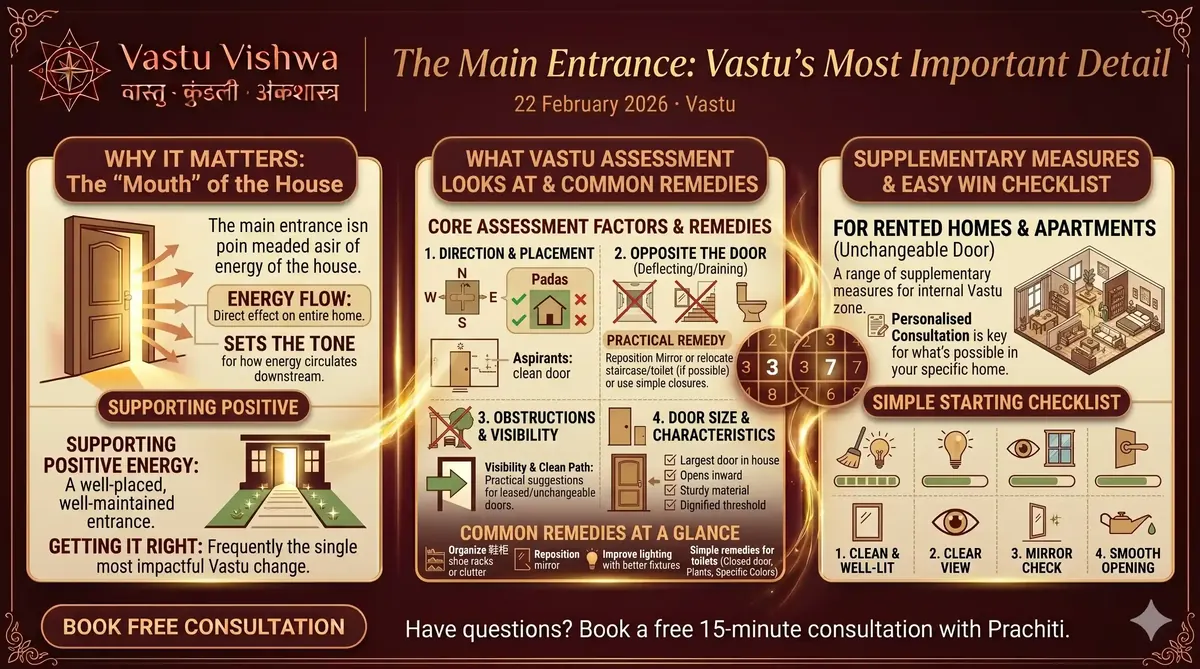
If there's one element of a home that Vastu consultations consistently return to, it's
the main entrance. It's often described as the "mouth" of the house — the primary point
through which energy, opportunities, and people enter. Getting this right is frequently
the highest-impact change a homeowner can make.
Why the main entrance matters so much
Every other room and element in a home is, in a sense, downstream of the entrance — it
sets the tone for how energy circulates through the rest of the space. A well-placed,
well-maintained entrance is considered to support the flow of positive energy inward,
while a poorly placed or obstructed one can work against even a well-laid-out home.
What a Vastu assessment looks at
- Direction and exact placement: As covered in our article on
north-facing homes, the direction is divided into smaller segments (padas) — and not
all segments within a direction are equally favourable.
- What's directly opposite the door: A mirror, staircase, or toilet
directly facing the main entrance is commonly flagged, as these can be seen as
"deflecting" or "draining" incoming energy.
- Obstruction and visibility: Pillars, large trees, or overhead water
tanks directly in front of the entrance are often discussed, along with practical
suggestions if removal isn't feasible.
- Door size and material: Traditionally, the main door is recommended
to be the largest door in the house, opening inward, and made of a sturdy material —
this is more about the door functioning as a clear, dignified threshold than strict
material rules.
- Lighting and cleanliness: A well-lit, clean, clutter-free entrance
is one of the simplest and most universally recommended practices — regardless of
direction or other factors.
Common entrance issues and practical remedies
Most entrance-related concerns have remedies that don't require structural changes:
- Shoe racks or clutter near the door can simply be relocated or organised
- A mirror facing the door directly can often be repositioned to a side wall instead
- Poor lighting can be improved with better fixtures or by keeping the area free of
shadows during the day
- If a toilet falls near the entrance zone, simple measures like keeping the door
closed, adding plants, or using specific colours are commonly suggested
What if you can't change your entrance?
For rented homes, apartments in larger buildings, or situations where the main door's
position genuinely cannot be altered, Vastu offers a range of supplementary measures —
from the placement of items near the entrance to how the immediate interior area
(the "Vastu zone" just inside the door) is arranged. This is often where a personalised
consultation adds the most value, since generic advice doesn't account for what's
actually possible in your specific home.
A simple starting checklist
- Is your main entrance clean, well-lit, and free of clutter?
- Is anything directly blocking the view into or out of the door?
- Is there a mirror directly facing the entrance from inside?
- Does the door open smoothly, without creaking or sticking?
These four checks alone can highlight quick wins — even before a full consultation
looks at direction-specific details.
Have questions about this topic?
Book a free 15-minute consultation with Prachiti to discuss your specific situation.
Book Free Consultation